
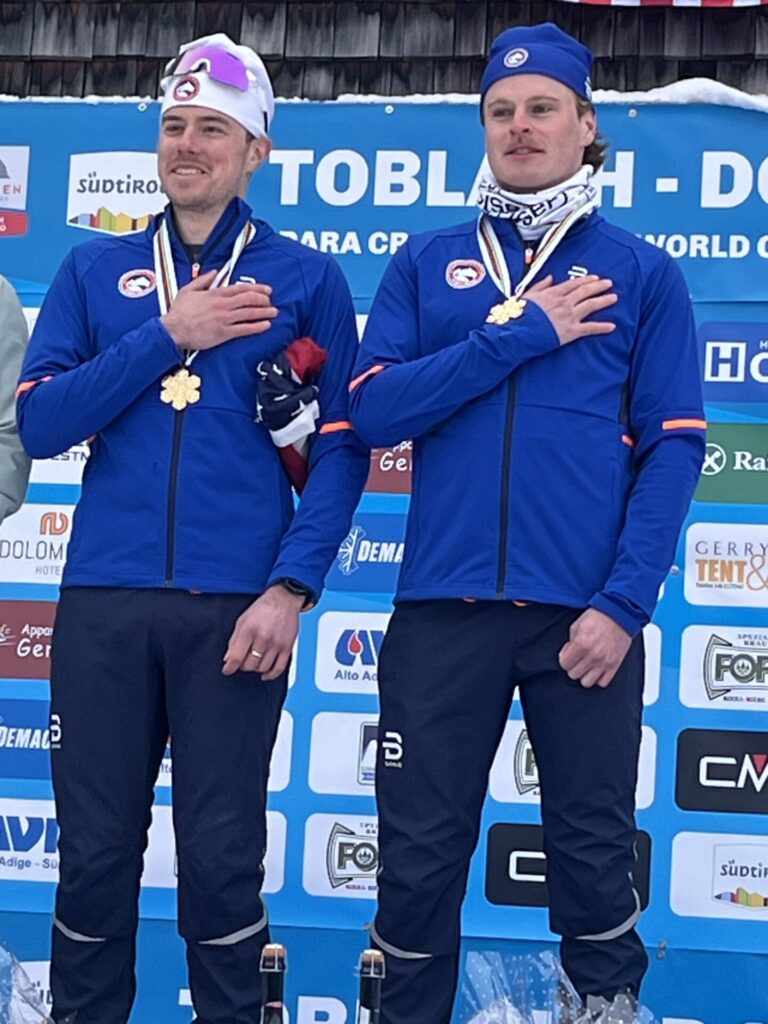
Jake Adicoff, a member of the U.S. Paralympic Team, is halfway to his goal of four gold medals at the 2026 Paralympics in Cortina, Italy. On Wednesday, Adicoff, won the men’s 10k classic with guide Reid Goble, following up his previous day’s performance skiing to victory in the men’s classic sprint with guide Peter Wolter.
Earlier this year, we wrote about Jake’s quest for skiing excellence. Below is the story that appeared in the 2026 Boulder Mountain Tour program in December. – Jody Zarkos
Skiing is Believing
Jake Adicoff was seven years old when he walked through the doorway at the Lake Creek Hut, home of the Sun Valley Ski Education Foundation’s cross-country skiing program. At the time, he had no way of knowing he was stepping into his future.
How could he? Jake, the youngest of his family’s three kids, just wanted to do what his friends were doing, and with coach Laurie Leman’s candy incentive, it was all the motivation he needed to show up for the Devo Program’s twice-weekly practice.
“One Sour Patch at each training session was enough to keep me going, plus I was terrible at baseball,” Jake remarked with a characteristic wryness. “I liked participating in the team environment and being with my friends.”
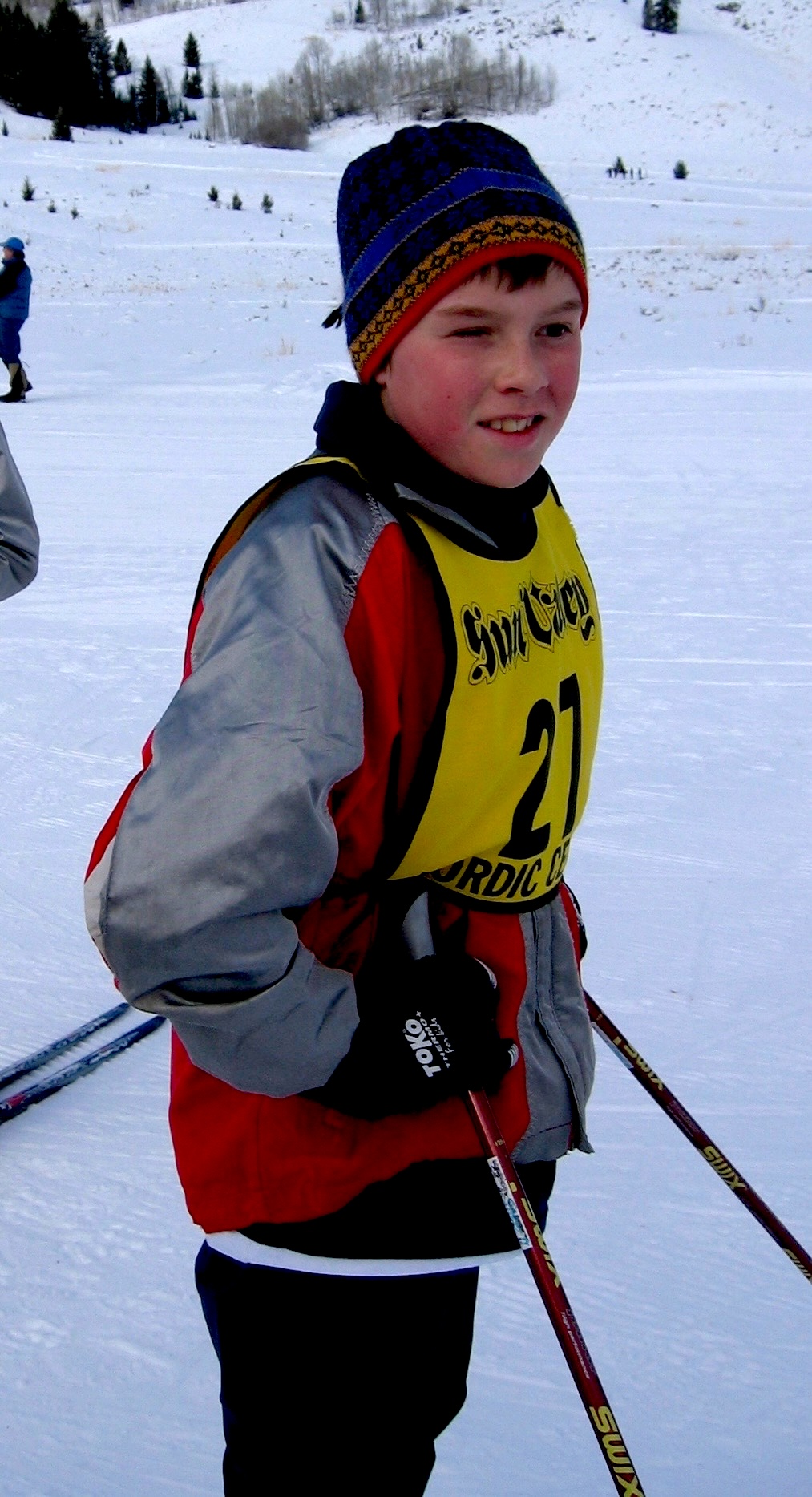
SVSEF’s Kelley Yeates recalled what it was like to coach Jake.
“Jake was everybody’s bud. Every single person on that team loved that kid.”
Due to contracting chicken pox in utero, Jake was born without any vision in his right eye and with limited scope in his left. But, interestingly enough, his brain maps a full visual field.
“I don’t see a ton of detail, and the threshold is a lot closer than someone who is nearsighted and can’t see detail far away,” Jake explained. “So much of this happened at a young age, I wasn’t really thinking about processing this stuff.”
With his typical sang froid, Jake threw himself into all the sports his friends were playing: soccer, baseball, skiing – both alpine and cross country – swimming, and riding a bike. He was always in the mix, determined not to be treated any differently than his friends.
SVSEF Coach Kelley Yeates has a classic memory of Jake that stands out as a touch point for other local skiers.
“We have a workout called the Cactus Hill Climb. We go up the hill and come down the backside, and it’s all sagebrush, rocky and uneven, and usually wet and snowy. We were hiking down together, and he was fine, so I went up ahead. Halfway down the hill, I thought to myself, ‘he can’t see where he’s going,’ and I went back to check on him. He’s smiling and having a blast.
“Having 20 or 30 percent eyesight never came out how he acted or behaved. He didn’t want to be treated like that. He always just found the fun in every little thing. I think he has a passion for skiing.
“So 20 years later, when my kids are complaining about the Cactus Hill Climb, I tell them the story about Jake.”
While a sophomore at Wood River High School, Jake set a goal of trying to make the Junior National Ski Team, which he did.
“It was the first time I committed myself to anything in sport and achieved it. It was a big moment in my self-actualization as a ski racer,” he said.
College Years
Armed with a well-honed identity as a ski racer built by innumerable hours of training, Jake embarked on college at Bowdoin in Brunswick, Maine, where he was a double-major in math and computer science. While college was Jake’s preliminary focus, he still threw himself into the East Coast carnival race circuit, a frenetic six-week white circus on snow.
“College skiing in the east is the most fun race circuit,” Jake says. “It is a grinding season with six winter carnival weekends in a row. You get in the flow: packing, training, racing, homework, and having three days to reset.”
Not only were the carnival weekends bonding for the skiers competing, but they became a galvanizing force for the Bowdoin Polar Bears.
“The team is so committed to what the group is doing. A significant part of it is team scoring. After the men would race, we would run next to the course and be screaming for the women’s team at the top of our lungs,” Jake said.
Similar to SVSEF’s skiing program under Rick Kapala, Bowdoin’s head coach, Nathan Alsobrook, established a program where everyone skiing for the Polar Bears developed or enhanced their lifelong love of Nordic skiing.
“It is a group buy-in thing. A lot of skiers on the team got to be really passionate about the sport, and everyone would feed off of it. (Bowdoin) was previously not a strong Nordic team. It was a cool time to be there. Now they have skiers who are competing for podiums every weekend. I attribute that to Nathan,” he said.
After graduating in 2018, Jake worked at Uber as a software engineer in the Bay Area, seemingly having hung up his racing skis, although job flexibility allowed him to get away on weekends to come back home or go to Colorado to ski.
“I missed winter, but what I missed even more was having something driving in my life,” he remarked. “I followed the path that I thought was expected. I thought I was done ski racing.”
Ski racing wasn’t done with him, however. Moving back to the valley in 2020 due to the Covid pandemic, Jake picked up where he left off, gravitating toward the Lake Creek Hut and his friends, training, skiing and viewing life through the lens of a committed athlete.
“Jake has always been a ‘glue’ guy on the Gold Team, and it was the same when he was a member of the Comp Team, Chris Mallory, a longtime SVSEF coach, remarked.
“My friends were here on the Gold Team – Katie (Feldman), Sam, Peter Holmes, and more. So, I went to training sessions and got back into shape. It took me leaving skiing for a few years to understand how important it was to have a big driving force in my life, have something I care about and have people on the same path, and the day-to-day is the social aspect. I didn’t get enough of that working – a driving force and people on the same path.”
Ketchum is rife with stories of people coming back with the intention of staying for a couple of weeks, and next thing you know, a few years have dissolved.
“It was the classic come home for a couple weeks. And I have been back five years now,” Jake said.
In the ensuing five years, Jake has skied his way to the pinnacle of his sport, but the path wasn’t always without big learning curves. Credit his analytical mind and focus; he always absorbed the lesson and came back with an answer that was right for him.
“He’s always kept it fun, been eager to seek out ways to improve and ways to push his limits. He’s someone who’s stoked to give back and hop in with our younger skiers, and I know our community is looking forward to watching him get after it in Milan, Cortina, this winter,” Mallory said.
Starting out
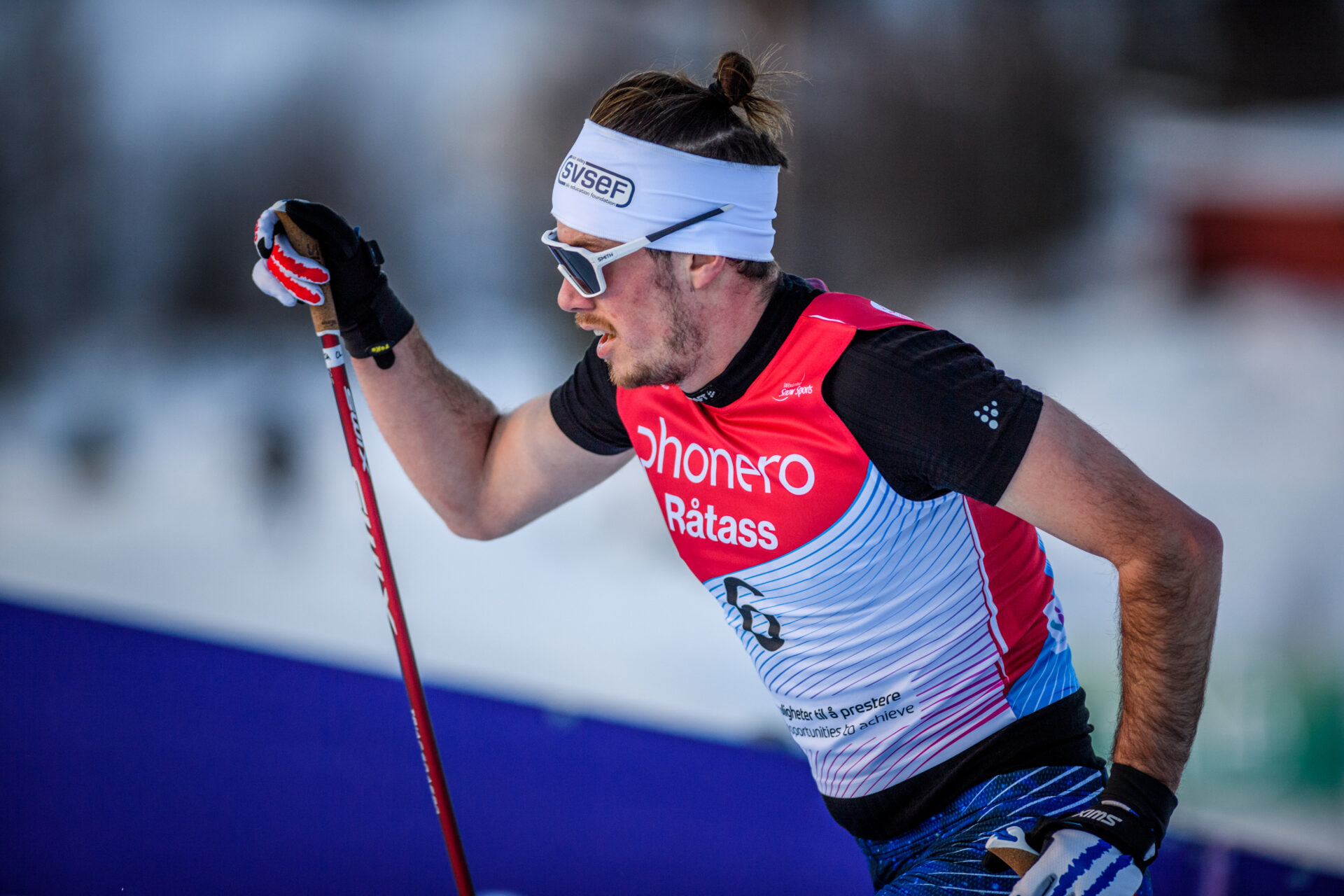
As a 19-year-old in 2014, Jake earned a berth on the US Paralympic Team, skiing at Sochi, Russia.
“I was pretty green,” he recalls. “There’s a lot of fanfare at the Games. A bit of it was Russian propaganda. The Russian people really care about sports. I was getting pulled aside by random people on the street to take pictures with me because I was wearing a Team USA jacket, and I hadn’t even participated in a race.
Skiing with guide Reid Pletcher, himself a SVSEF alumnus, Jake was the top American and sixth overall in the men’s 20km freestyle. He went on to take seventh in the 10km classic two days later, again finishing as the top American.
Four years later, in 2018, the Paralympics were held in PyeongChang, South Korea, and fresh off his college circuit in his senior year, Jake had an entirely different set of expectations for himself.
“I went into the Games knowing medals were a possibility. I didn’t have that in Sochi, and it put a lot of pressure on me. I had moments of failure. The first race was a 20k skate, and I think I was expecting to be on the podium. I put a lot of pressure on myself, and I exhausted myself with nervousness.”
Jake and guide Sawyer Kesselheim finished fifth. In the classic sprint, they were disqualified for a technique infraction, but in the second-to-last race, a 10k classic, things aligned for Jake.
“I had great skis, I felt really good, and I had a really good day out there,” he said.
Jake was the silver medalist, finishing behind the legendary Brian McKeever, the most decorated Canadian paralympian of all time with 20 medals – 16 gold – to his credit.
“It was pretty cool. Just a kind of satisfaction that I had gotten a piece of what I came there to do,” he summed up.
Paralympics
Jake explains that there are three classes of visual impairment: NS1 (no sight), NS2 (limited sight with light perception and a visual field of less than 5 degrees), and NS3 (visual field constricted to a radius of less than 20 degrees).
Skiing in the NS3 class, Jake can see well enough that he doesn’t always need a guide, as was the case when he competed in high school and college, and he acknowledges there are advantages and disadvantages to skiing with a guide.
“You have to sacrifice a little bit of your autonomy as far as racing goes. They tend to take over pacing of the race. When you are skiing alone, you are constantly making very small adjustments throughout the race to manage lactate and how hard you push. You have to surrender that autonomy because you can’t have constant conversations. You can talk, and we do, but in general, you need to speed up or slow down.”
Another challenge is that Jake is so fit, and with the guide up ahead, they tend to burn out faster as they are pulling a majority of the race, especially if it is flat or windy.
“It doesn’t matter how fast they are,” Jake remarked.
A single skier can have multiple guides, and Jake is blessed to be surrounded by a cadre of high-octane talent like Peter Wolter, Sam Wood, Reid Goble, and Sawyer Kesselheim over the past few years, and they have shared the highs and lows.
“When he came back to skiing in ‘21, the Gold Team really helped in his success at the 2022 Paralympics. His teammate, Sam Wood, ended up being a fantastic guide for him for a few years, and now Peter Wolter. Having them train side by side, day in and day out, they are like clockwork when it comes to race days, and Jake has been able to have a long career in the sport,” Mallory said.
“I am pretty fired up to have some of the top skiers around,” Jake said.
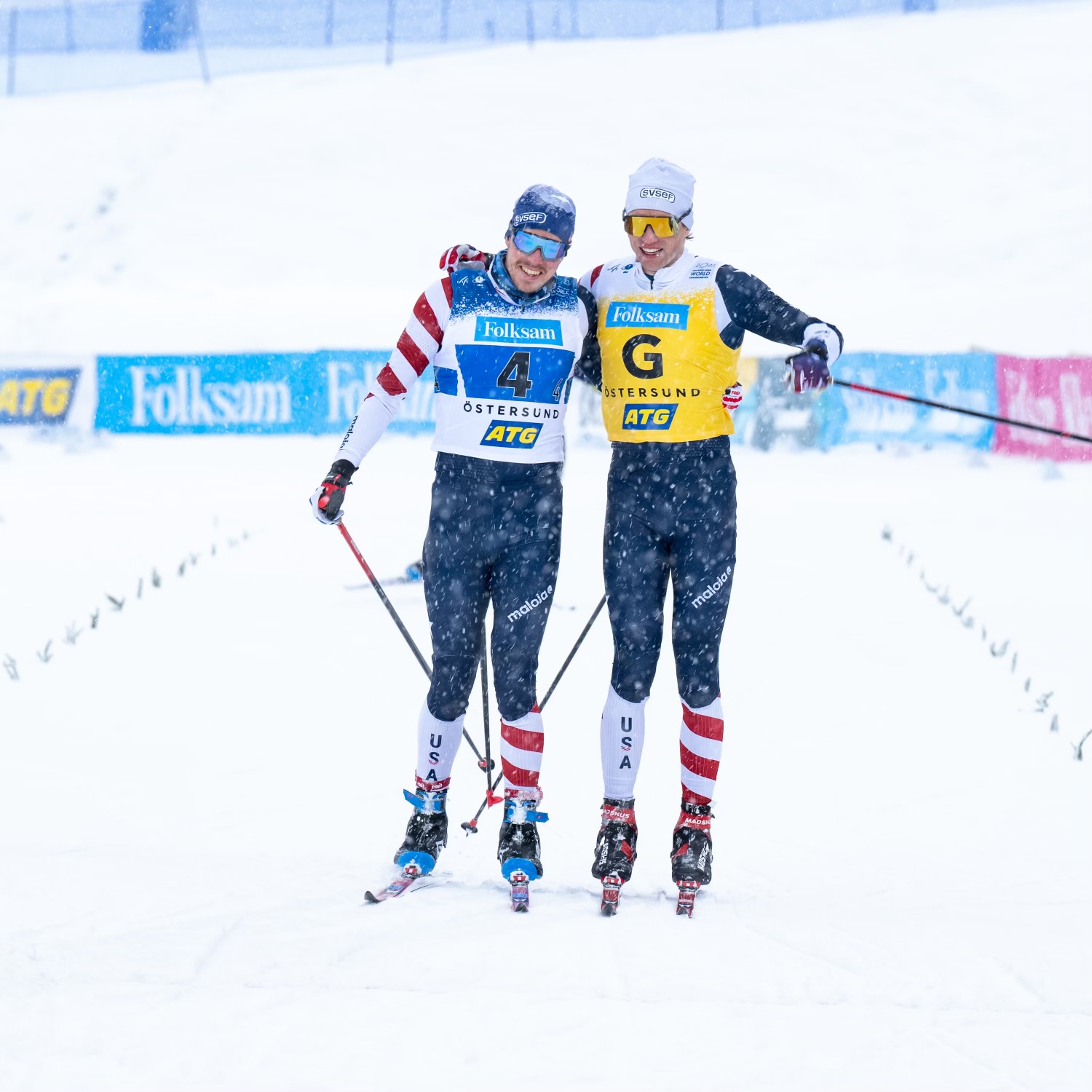
Photo by Ralf Kuckuck.
Decision Time
In 2020, Jake was training but admits, “I was choosing how hard I would go. I wasn’t super committed to progressing.”
It took his roommate’s proposal to propel Jake back to the fast lane.
“In the spring of 2021, Sam (Wood) and I were on a run, and he said, ‘I think you should start skiing again, and I will be your guide.’ I sat with it for a week. I guess it opened up that it was a real possibility – that I could dust off a three-year dormant career as a skier.
“It was extremely challenging.”
Jake leaned on his para coaches based in Bozeman, Montana, but his “main guy” was Chris Mallory, head coach of the SVSEF Gold Team and a fixture at SVSEF for the last 20 years.
“There was a lot of racing that year with the goal to expect the games. But bringing it down to the basics, including how to ski race again, and committing it to memory. A lot of the processes are super mundane. You wake up, how do you control your energy? Are you excited but not too excited? What are you eating? What is your schedule like? What is your warm-up? That year, the biggest fear was overtraining. I hadn’t done a serious year of training, and being too tired was a fear that was definitely in the background.”
All of Jake’s training could not prepare him for the 2022 Paralympics in Beijing, China.
“It was the worst ski trip ever. It was miserable. Stressful with Covid stress. We all knew the narrative the organizing committee put forth. Within 14 days, if you tested positive, you weren’t going. In the village, stress continued. Put a damper on good vibes in general. Not unique to me. There were just logistical things. In China, we were allowed to go from village to venue and back to the village. It was impossible to escape. We were in a room that had a window into a hallway for almost three weeks.”
Despite the challenging circumstances, Jake had some standout moments.
“I went in wanting four gold medals, but I don’t know if I believed I could do it. There were some bright moments and a few times when I was enjoying myself, he said.
Jake and Sam skied to silver medals in the long-distance classic race, freestyle sprint, and captured their first Paralympic gold in the 4×2.5 mixed relay.
“There are lots of times, as a ski racer, you get beat down for multiple months, and there are a lot of times when you’re not racing well for long periods, and you start to really question your participation in the sport. Through all of this, I will return to this baseline as someone who really cares about it and loves it. I fundamentally know that I am there because I want to be and love the sport,” he said.
Ciao, Italy
Over the last three years, Adicoff has stepped onto podiums on stages throughout the world, epitomizing the SVSEF motto, “From grass roots to the grand stage.”
In 15 World Cup starts, he’s amassed 10 wins and four second-place finishes. He is a four-time World Champion and four-time runner-up, most recently in Toblach, Italy, not far from where he will compete in his fourth Paralympics, the 50th anniversary of the Paralympic Winter Games, March 6-15 in the Arena di Verona. An estimated 600 athletes will compete in six disciplines: cross-country skiing, alpine skiing, biathlon, ice hockey, snowboard, and wheelchair curling.
“I guess there is a decent chance that this is my final year skiing. In the moments I am not really thinking about. In the goal-setting process with the Para team, my goal is I want four gold medals – three individual medals and a relay. It is attainable. It is going to be a challenge, but I believe it is a possibility. I really believe it is the time. I know that if things go well. If I am racing well and feeling good, it is attainable.”
And the young man, who continued a sport in a large part because it gave him a community and purpose, will find all that on a much larger stage that he probably never even envisioned when he walked through the front door of the Lake Creek Hut so many years ago. In the ensuing 23 years, Jake continues to walk through doors. But this time, he knows exactly where he is going.